Header image alt text

Joyce Clark Unfiltered

For "the rest of the story"

My informal poll is to the left of this column.

Ok. We are down to the wire. This Tuesday is the country’s official election day but many of us have already voted. I am going to leave this informal poll up until Tuesday evening.

This may be the most consequential election of our lifetimes.

Who did you vote for? This poll is anonymous. There is no way to trace or figure out who voted which way. You only get to vote once.

Disclaimer: The comments in this blog are my personal opinion and may or may not reflect an adopted position of the city of Glendale and its city council.

I recently read an article in the Epoch Times, dated October 27, 2020 regarding recreational marijuana use in Pueblo Colorado.  Here is the link: https://www.theepochtimes.com/the-true-cost-of-marijuana-a-colorado-town-that-went-all-in_3546091.html?utm_source=newsnoe&utm_medium=email&utm_campaign=breaking-2020-10-27-4 . I urge you to read the entire article.

Pueblo, like the rest of Colorado, allows recreational use of marijuana. It’s a town smaller than Glendale with a population of about 160,000. There is no doubt that marijuana is earning a ton of money for the town—about $100,000 in sales tax monthly. That’s over a million dollars in sales tax a year for the city. The industry employs about 2,000 people at a rate of $12 to $15 an hour. Sounds good, doesn’t it?

However, the article shares the experiences of several Pueblo emergency physicians and now the picture is not quite so rosy. They say the harmful effects far outweigh any monetary benefits. Many people end up in the ER with something called cannabinoid hyperemesis. The cause is chronic cannabis use of high-potency products and stops when the use of cannabis stops. The main ingredient in marijuana is THC (tetrahydrocannabinol). Twenty, thirty years ago a marijuana joint contained about 4% THC. Now the potency is pegged at more than 80%. Then there are the issues of psychosis and schizophrenia typically affecting 17, 18 and 19 year olds.

Pueblo and all of Colorado has seen an increase in all drug use and not just marijuana. Marijuana is a gateway drug that often leads to the use of opiates. Methamphetamine use is up 143 percent, opiates are up by 10 percent, and cannabis is up by 57 percent, according to data from the ER drug screens over the past seven years.

Then there are the not so obvious results. It is much more difficult for employers to find sober workers. There is the effect of more school drop outs and those not dropping out have more difficulty in learning resulting in a larger, unsatisfactorily educated work force. And while town coffers may be bulging, health care costs have increased dramatically. Public safety spends more and more time answering overdose calls taking them away from more serious medical emergencies and crimes.

Arizona already allows the use of medical marijuana and the system is often abused but that action should not be used to allow the use of recreational marijuana. What are we doing to our people ? And most especially to our kids? Aren’t we obligated to protect them?

It’s on the Nov. 3rd ballot. The choice is yours.

© Joyce Clark, 2020         

FAIR USE NOTICE

This site contains copyrighted material the use of which is in accordance with Title 17 U.S. C., Section 107. The ‘fair use’ of any such copyrighted material as provided for in Section 107 of the US Copyright Law and who have expressed a prior interest in receiving the included information for research and educational purposes. For more information material on this site is distributed without profit to those who have not always been specifically authorized by the copyright owner. We are making such material available in our efforts to advance understanding of environmental, political, human rights, economic, democratic, scientific and social justice issues, etc. We believe this constitutes a ‘fair use’ of any such material. For more information go to http://www.law.cornell.edu/uscode/17/107.shtml. If you wish to use copyrighted material from this site for purposes of your own that go beyond ‘fair use,’ you must obtain permission from the copyright owner.


Comments in this blog are my personal opinion and may or may not reflect an adopted position of the city of Glendale and its city council.

As you may, or may not be aware, I have been working hard to make Heroes Park Lake a reality. I am pleased to share this first rendering of Heroes Park Lake to be located on the east side of 83rd Avenue just north of Bethany Home Road at Heroes Regional Park. This rendering shows the position and size of the lake (approximately 5 acres) but it does not show ‘the bells and whistles’ that will be incorporated. Since it will be a fishing lake there will be a few fishing piers, a 20’ foot fountain, several shade structures, benches and the planting of larger trees (none of which is depicted in this rendering).

I am so excited and pleased to be able to finally announce that this lake is definitely coming to the park and soon. There are a lot of moving parts that complicated this project including coordination with Salt River Project. Final details on the amenities are still to be determined and finalized. The latest schedule is that work will begin in the first quarter of this coming year, around this coming March or April.

 I thank all city personnel that will make this project a reality. If I omit some names, please accept my apology. Thanks to City Manager Kevin Phelps, Assistant City Mangers Jack Friedline (technical) and Vicki Rios (financing), Don Bessler, Special Projects Engineering and Trevor Ebersole, Director of Transportation and Streets (includes engineering). Many more were involved. My thanks also goes to the entire City Council. Without their approval this project would never have occurred. I appreciate their recognition of and commitment to fulfilling the city’s promise to complete Heroes Park. My thanks to every Yucca district resident for your patience. You have had to wait over 20 years to see this park completed. I believe the lake is just the beginning of the road to placing all elements within this park.

© Joyce Clark, 2020         

FAIR USE NOTICE

This site contains copyrighted material the use of which is in accordance with Title 17 U.S. C., Section 107. The ‘fair use’ of any such copyrighted material as provided for in Section 107 of the US Copyright Law and who have expressed a prior interest in receiving the included information for research and educational purposes. For more information material on this site is distributed without profit to those who have not always been specifically authorized by the copyright owner. We are making such material available in our efforts to advance understanding of environmental, political, human rights, economic, democratic, scientific and social justice issues, etc. We believe this constitutes a ‘fair use’ of any such material. For more information go to http://www.law.cornell.edu/uscode/17/107.shtml. If you wish to use copyrighted material from this site for purposes of your own that go beyond ‘fair use,’ you must obtain permission from the copyright owner.

Disclaimer: The comments in this blog are my personal opinion and may or may not reflect an adopted position of the city of Glendale and its city council.

Before I share my thoughts let me say that I voted and dropped my permanent early ballot off on Thursday at the drop box located in the sub-basement of Glendale’s City Hall.  I waited until Saturday and went online to ballotstatus.maricopa.vote to check my ballot status. I filled in a few questions for identity verification and clicked submit. It immediately verified that my ballot had been received and my vote counted. It couldn’t have been simpler. I urge you, if you have a Permanent Early Ballot that you take a moment to fill it out and drop it off at a secure drop box location.

My remarks are directed at those who have not yet voted or will do so in person on Election Day. Let me preface my comments with this. I first registered to vote during my college years at the time of the Presidency of John F. Kennedy. I, like so many, admired this President and so, I registered as a Democrat and remained so for almost 50 years and actually voted for Obama and his first term. Obama’s performance was so disappointing that it was at that time that I began voting Republican and eventually changed my registration from Democrat to Republican. I proudly voted for Donald J. Trump.

In 9 days this nation will make a decision on who will be our President. It’s been said often and although it seems trite this election will most certainly determine if this nation remains a Republic, “if we can keep it.”

We should not be judging these candidates based on personality but that is not reality and so, we do. It is not personality but policy that drives my decision. Trump is a salesman and has always been so – he’s not a career politician in the true sense of the word. He blusters and he exaggerates but those actions should not be confused as lying. He’s not the perfect person but then again, neither is Biden.

Biden is cognitively declining. I’ve seen it occur before in my parents. He exhibits ‘tells’ that I saw in my parents. I believe he is no more than a Trojan Horse filled with Progressives that will be released moving this country into Socialism should Biden win.

Enough with personalities. Policy issues are far more important. Let’s begin with economic policies. It cannot be denied that prior to COVID this economy was roaring. Trump often points to the stock market’s performance. My 401K rose dramatically under Trump’s administration. Before you discount the stock market’s importance, think about this. Are you a teacher? police officer? fire fighter? Where do you think your pension funds are parked? In the stock market. When the stock market does well that bodes well for the futures of many ordinary Americans.

Trump’s policies of tax cuts and reduction regulation led to the prosperity of many while pulling Afro-Americans, Hispanics, women, etc. off the unemployment rolls in historic, record busting numbers. We saw a real wage growth of 6% for blue collar workers. Countless new, small businesses were created and manufacturing came back to America. In nationwide polling more Americans (56%) still believe that Trump will do a better economic recovery job than Biden.

Biden has said repeatedly that he will only raise taxes on those making more than $400,000 annually but he has also said that on his first day he will eliminate Trump’s tax cuts. Independent, neutral tax policy groups have confirmed that Biden’s elimination of those tax cuts will cost 82% of all American families about $6,500 each. Biden would also reinstate the death tax and raise the capital gains tax.  The passing down of small, family farms would once again be in jeopardy and that 401K when you take money out of it will be taxed far more.

Energy policy is another issue with stark differences. Under the Trump administration America is finally energy independent. The consequence of energy independence drives foreign policy and creates a rationale to keep America out of foreign wars, especially in the Middle East.  Trump supports the use of fossil fuels and fracking and the millions of jobs these policies sustain.

Biden has flip flopped all over. He’s for fracking and then he’s against fracking. Remember that the occupants of the Biden Trojan Horse (Progressives) are adamantly opposed to fossil fuels and support the New Green Deal. Biden, in the final Presidential debate, admitted that he would eliminate all federal subsidies for oil production and fracking. In essence, he is willing to sacrifice our energy independence for a model similar to that of California’s. How’s that working out? Today, one million Californians will once again have their power turned off due to wildfire prevention. The problem with that is wind and solar are incapable of making up the difference in electrical power generation. Hence the blackout.

COVID is another issue that provides differences between the candidates. It’s a choice between optimism and pessimism. Biden said in the final debate that America faces its darkest days ahead. Trump believes that the cure should not be worse than the disease. Truthfully whether Biden or Trump had been in the White House today’s current condition would have been the same. Our fatal mistake, now that America is experiencing a 3rd wave of the virus, is that we should have been protecting the old and the vulnerable and kept the country running. This 3rd wave is due to the fact that the country never built up ‘herd immunity’ and now that so many people are sick of wearing masks (BTW I still wear one) and social distancing not enough of the population has immunity to fight the disease. I suspect this 3rd wave will finally result in the population immunity needed.

There are certainly more stark differences between the policies of the two Presidential candidates but I want to focus on one that especially bothers me as a local, elected official and that is the Affirmatively Affordable Fair Housing Act (AAFHA). President Obama signed an Executive Order establishing this act in 2013 and Trump, via Executive Order in 2018, rescinded it. Thankfully, during its 5 years of existence it was a policy that was never aggressively pushed. In essence, it federally mandated local jurisdictions to implement a plan to create more affordable housing within their communities. If they did not do so their Community Development Bloc Grants (CDBG) and Surface Transportation Bloc Grants (STBG) would be denied. Biden has stated that he would reinstate this policy. This policy would eliminate local control over zoning. A vacant parcel near your home zoned for residential development could end up being developed with a low income affordable housing project on it instead. This act, if implemented, would do more to destroy the fabric of many communities than anything in recent memory.

I know that half of my audience is Democrat and obviously, the other half is Republican but there are still many undecided voters, anywhere from 2% to 6% of the electorate. You, the undecided voter, may very well determine who our President will be. I urge you to put aside your like or dislike based on personality. You must decide based upon policy and what kind of future you would like for you, your family and the country. Even more importantly you have the obligation and the right to vote…something citizens in many countries cannot do freely.  It’s up to you. We still have a Republic but can we keep it?

© Joyce Clark, 2020         

FAIR USE NOTICE

This site contains copyrighted material the use of which is in accordance with Title 17 U.S. C., Section 107. The ‘fair use’ of any such copyrighted material as provided for in Section 107 of the US Copyright Law and who have expressed a prior interest in receiving the included information for research and educational purposes. For more information material on this site is distributed without profit to those who have not always been specifically authorized by the copyright owner. We are making such material available in our efforts to advance understanding of environmental, political, human rights, economic, democratic, scientific and social justice issues, etc. We believe this constitutes a ‘fair use’ of any such material. For more information go to http://www.law.cornell.edu/uscode/17/107.shtml. If you wish to use copyrighted material from this site for purposes of your own that go beyond ‘fair use,’ you must obtain permission from the copyright owner.

Disclaimer: The comments in this blog are my personal opinion and may or may not reflect an adopted position of the city of Glendale and its city council.

I first began this blog in the spring of 2013. Since its inception I have written 860 posts centered on issues related to Glendale, from ‘hot button’ topics like the current Glen Lakes issue to past issues including chickens! I have received nearly 3,000 reader comments. My subscribers span the globe from Zimbabwe to China to Kuwait.

I want to thank all of my subscribers for following me these many years! It makes the effort worthwhile. I intend to continue to offer my perspective on Glendale issues until I can no longer see or write. Sometimes you may agree with my take and sometimes I am sure I have angered others. That’s great because it highlights an issue, makes the reader think and hopefully offers a forum to weigh in with your opinion on the topic.

Again, thank you…

Number of reads as of October 24, 2020

© Joyce Clark, 2020         

FAIR USE NOTICE

This site contains copyrighted material the use of which is in accordance with Title 17 U.S. C., Section 107. The ‘fair use’ of any such copyrighted material as provided for in Section 107 of the US Copyright Law and who have expressed a prior interest in receiving the included information for research and educational purposes. For more information material on this site is distributed without profit to those who have not always been specifically authorized by the copyright owner. We are making such material available in our efforts to advance understanding of environmental, political, human rights, economic, democratic, scientific and social justice issues, etc. We believe this constitutes a ‘fair use’ of any such material. For more information go to http://www.law.cornell.edu/uscode/17/107.shtml. If you wish to use copyrighted material from this site for purposes of your own that go beyond ‘fair use,’ you must obtain permission from the copyright owner.

Disclaimer: The comments in this blog are my personal opinion and may or may not reflect an adopted position of the city of Glendale and its city council.

I have received a lot of calls, emails and text messages from citizens wanting an explanation of Proposition 437. They say the city has not provided any information on this issue. If you go to www.glendaleaz.com on the landing page there is a link to get you to the information about Proposition 437 and the 4 ballot questions asking for voter approval for bond authorization. 

You may have wondered why the city is not asking voters to vote ‘yes’ on Proposition 437 and the 4 bond questions. By state statute a city may not advocate for or against issues presented to the voters when they are city initiated. The city has held at least a dozen public informational meetings on these issues where information about them was presented by staff being careful not to advocate for the issues presented.

With Proposition 437 the city is asking for voter approval to grant a franchise agreement between the city and EPCOR Water Arizona, Inc. Approval would allow EPCOR to construct, maintain and operate water and wastewater utilities within the city including any future annexations, west of 115th Avenue. EPCOR has been providing water and wastewater services to many entities both commercial and residential west of 115th Avenue for many years. All of their current  service provision has been on county land not incorporated Glendale land. Since they are already operating in that area and already have the infrastructure in place to provide services it makes sense to grant them the right to service properties in Glendale’s Municipal Planning Area (MPA) as those properties are annexed into Glendale.

The city council approved a policy for future annexations in far West Glendale that mandates the area be used for industrial, commercial and retail development, most particularly around the Loop 303 area. With EPCOR already providing water and sewer services in that area it does not require the city to invest millions of dollars in putting in the needed infrastructure there.  EPCOR already has customers and operates in that area as well as in some West Valley cities.

Voter approval of this franchise agreement in no way affects current city water and wastewater customers now getting those services from the city. There is no relationship between the two services. Those people who get water and wastewater services from the city will continue to get those services. Approval of this franchise agreement eliminates the need to expand city infrastructure beyond 115th Avenue. If the voters do not approve this franchise agreement then Glendale may have to build infrastructure in far west Glendale. In this scenario every current customer would bear the associated costs. 

As a franchisee of the city EPCOR will be required to pay the city three percent (3%) of its annual gross (not net) receipts. The estimated annual payment to the city is $825,612.

It’s a win-win for the city and for EPCOR. I would recommend a ‘yes’ vote.

Please note my previous blog presented information not just on this issue but on the 4 bond questions that are on the ballot.

  FAIR USE NOTICE

This site contains copyrighted material the use of which is in accordance with Title 17 U.S. C., Section 107. The ‘fair use’ of any such copyrighted material as provided for in Section 107 of the US Copyright Law and who have expressed a prior interest in receiving the included information for research and educational purposes. For more information material on this site is distributed without profit to those who have not always been specifically authorized by the copyright owner. We are making such material available in our efforts to advance understanding of environmental, political, human rights, economic, democratic, scientific and social justice issues, etc. We believe this constitutes a ‘fair use’ of any such material. For more information go to http://www.law.cornell.edu/uscode/17/107.shtml. If you wish to use copyrighted material from this site for purposes of your own that go beyond ‘fair use,’ you must obtain permission from the copyright owner.

Disclaimer: The comments in this blog are my personal opinion and may or may not reflect an adopted position of the city of Glendale and its city council.

As voters receive Early Ballots and we are 3 weeks away from voting in person, it’s a good time to review the items related to Glendale on the ballot..

The first is Proposition 437. The city is asking voters to approve granting a franchise agreement to EPCOR Water Arizona, Inc. Approval would allow EPCOR to construct, maintain and operate water and wastewater utilities within the city including any future annexations, west of 115th Avenue.

The city council approved a policy for future annexations in far West Glendale that mandates the area be used for industrial, commercial and retail development, most particularly around the Loop 303 area. With EPCOR providing water and sewer services it does not require the city to invest millions of dollars in putting in the needed infrastructure in that area.  EPCOR already has customers and operates in that area as well as in some West Valley cities.

Granting voter approval for this franchise agreement in no way affects current city water and wastewater customers now getting those services from the city. There is no relationship between the two services.  As a franchisee of the city EPCOR will be required to pay the city three percent (3%) of its annual gross (not net) receipts. The estimated annual payment to the city is $825,612. It’s a win-win for the city and for EPCOR. I would recommend a ‘yes’ vote.

There are also 4 Bond Questions on the Nov. 3rd ballot. The city issues bonds to pay for Capital Improvement Projects. These bonds are paid off over time, usually 25 or 30 years. The city has committed that it will issue no more bonds than that which can be paid off while keeping your property tax rate at its current rate. In other words, passage of these bond questions will not raise your property tax bill.

Question 1 is for Parks and Recreation in the amount of $87,200,000. These bonds would not be issued all at once but rather as other bonds are paid off that allows the city to issue new bonds without raising your property tax. Here are the specific projects for which the bonds will be used:

  • Existing citywide park infrastructure improvements $31,819,400.00
  • Heroes Regional Park Lake                                      4,435,000.00
  • O’Neil Park Splash Pad                                            1,350,000.00
  • Park play structures city wide                                  3,195,000.00
  • Heroes Regional Park Build Out                             46,400,000.00

Question 2 is for Streets in the amount of $81,500,00. and lists specific streets that will be reconstructed. It costs between $3M and $4M to reconstruct one mile of arterial street. The specific streets are:

  • 67th Ave (Greenway to Bell Rd)                      $3,528,000.00
  • 67th Ave (Deer Valley Rd to Pinnacle Peak Rd) $3,704,400.00
  • 59th Ave (Glendale to Northern Ave)               $3,704,400.00
  • Cactus Rd (59th to 67th Ave)                           $3,704,400.00
  • 51st Ave (Peoria Ave to Cactus Rd)                 $3,528,000.00
  • 51st Ave ( Olive Ave to Peoria Ave)                 $3,616,200.00
  • 75th Ave (Glendale Ave to Northern Ave)         $3,528,000.00
  • 83rd Ave (Glendale Ave to Northern Ave)         $4,254,000.00
  • Arterial Street Reconstruction identified in the Capital Improvement Program (Years 6 through 10)   $51,932,600.00        

Question 3 is for the Landfill in the amount of $9,900,000.00 and any bonds issued will not be paid back from the General Fund. These bonds will be paid back by the consumers/rate payers that use city sanitation services.  Current bond repayments for previously issued bonds are already part of your monthly sanitation bill. These funds will be used for expansion of the city’s landfill as it opens the north cell and closes the south cell.   

Question 4 is for Flood Control in the amount of $9,300.000 and will be used for 3 specific projects:

  • Storm drains, Camelback Rd ( 51st Ave to 58th Ave)                       $2,776,400.00
  • Storm drains, 83rd Ave (Bethany Home to Camelback)                    $3,129,500.00
  • Drainage improvements, Glenn Dr (52nd Ave to 59th Ave)                $3,394,100.00

If all or any of these 4 Bond Questions do not pass, there will be no bond money to pay for them. The city options are to not build the project or scale it back. It should also be noted that when voters approve these bond questions, the bonds issued can only be used for the specific projects on the ballot that were voter approved.

I ask that you carefully consider all 4 questions. If you think they are worthy of investment then you will vote to approve them as I am doing.

© Joyce Clark, 2020         

FAIR USE NOTICE

This site contains copyrighted material the use of which is in accordance with Title 17 U.S. C., Section 107. The ‘fair use’ of any such copyrighted material as provided for in Section 107 of the US Copyright Law and who have expressed a prior interest in receiving the included information for research and educational purposes. For more information material on this site is distributed without profit to those who have not always been specifically authorized by the copyright owner. We are making such material available in our efforts to advance understanding of environmental, political, human rights, economic, democratic, scientific and social justice issues, etc. We believe this constitutes a ‘fair use’ of any such material. For more information go to http://www.law.cornell.edu/uscode/17/107.shtml. If you wish to use copyrighted material from this site for purposes of your own that go beyond ‘fair use,’ you must obtain permission from the copyright owner.

Disclaimer: The comments in this blog are my personal opinion and may or may not reflect an adopted position of the city of Glendale and its city council.

On September 29, 2020, Glendale resident Ron Short sent a letter to the Mayor and all Councilmembers regarding Glen Lakes. The entire council appreciates hearing from citizens and values their comments and takes them under consideration when making decisions. I have the utmost respect for Mr. Short. He is a valuable member of our community. In fact, he is a former employee of the city and worked in the Planning Department working on historic properties. Although at some time he may have, I don’t remember his working on any new development or redevelopment applications (unless they had a historical component). His area of expertise was that of historic property preservation.

In his letter he questioned whether the city is an appropriate applicant. Unfortunately, he ‘cherry picked’ the City Code, Section 3.803 – Authorized Applicant. He referenced A. 5., only one of the 6 permissive applicants listed, “5. The Planning Commission or City Council on its own motion at a public meeting; or.”

The complete Section 3.803 – Authorized Applicant., as follows:

“A. An application for an amendment to change the zoning on any property shall be one (1) of the following:

  1. The owner of the property;
  2. One (1) or more of several join owners of property who own individually or as a group, a majority interest in the property;
  3. One (1) or both of the property owners where property is held in joint tenancy;
  4. Seventy-five (75) percent, or more, of the owners of property in the area covered by the application when the application covers more than one (1) property;
  5. The Planning Commission or City Council on its own motion at a public meeting; or
  6. The Historical Preservation Commission, the Planning Commission or City Council on its own motion at a public meeting, may initiate an amendment to establish or amend Historic Preservation District Zoning.”

Fact:   The applicant for the amendment is the city, owner of record at the time the amendment was filed and meets number 2 of the above Section 3.803. Mr. Short refers to an agreement with Homes by Towne dated December 11, 2019. That was the initial agreement agreeing in principle to sell under certain conditions. The actual sale and close of escrow occurred at a much later date.

Mr. Short, within his letter, then makes reference to the required landscape area referring to Code Section 19-62, On-Site Landscaped Areas and quotes, All development projects covered by Section 19-4 here shall provide on-site landscaped areas located in accordance with the following standards and requirements: (3) For all development within other zoning districts, landscaped areas shall be provided on the site in an amount equal to or greater than twenty (20) percent of the net site area.”

Let’s see what Section 19-4 actually says and requires. “The provisions of this chapter shall apply to all development or construction, all building remodeling, alterations, additions, or expansions, and to all changes of occupancy in the use or development of land which requires the approval of a development site plan or subdivision plat by the city. Agricultural uses and single-family and two-family residences and their accessories shall be exempt from the requirements of this chapter.” Once again Mr. Short chose one sentence to make his case without bothering to review Section 19-4, his citation, to see if it applied to this development project comprised of single family residences.

Mr. Short also fails to recognize that city code with reference to a Planned Residential Development (PRD) allows for public open space to be a part of the development. The developer in required to build the park (on his dime) and then must dedicate the park to the city as public open space. The requirements for specifications and maintenance of the park area are the responsibility of the city, not the developer, which is his assertion.

Mr. Short refers to the ‘boom times’ the city is currently experiencing and therefore there is no need to sell Glen Lakes Golf Course. Boom times don’t last forever and are often followed by ‘bust’. When ‘bust’ does come, everything is on the table for consideration as to whether it is an essential component of city service delivery. Historically, the city has spent millions of dollars to preserve Glen Lakes Golf Course and if retained would continue to spent considerably more. A component of council’s decision was the question, is it fair and equitable to all city taxpayers to continue to subsidize this golf course? That is a complicated question that each councilmember must decide for himself or herself. Each will have come to a final conclusion when it comes before council for a vote this month.

© Joyce Clark, 2020         

FAIR USE NOTICE

This site contains copyrighted material the use of which is in accordance with Title 17 U.S. C., Section 107. The ‘fair use’ of any such copyrighted material as provided for in Section 107 of the US Copyright Law and who have expressed a prior interest in receiving the included information for research and educational purposes. For more information material on this site is distributed without profit to those who have not always been specifically authorized by the copyright owner. We are making such material available in our efforts to advance understanding of environmental, political, human rights, economic, democratic, scientific and social justice issues, etc. We believe this constitutes a ‘fair use’ of any such material. For more information go to http://www.law.cornell.edu/uscode/17/107.shtml. If you wish to use copyrighted material from this site for purposes of your own that go beyond ‘fair use,’ you must obtain permission from the copyright owner.

Disclaimer: The comments in this blog are my personal opinion and may or may not reflect an adopted position of the city of Glendale and its city council.

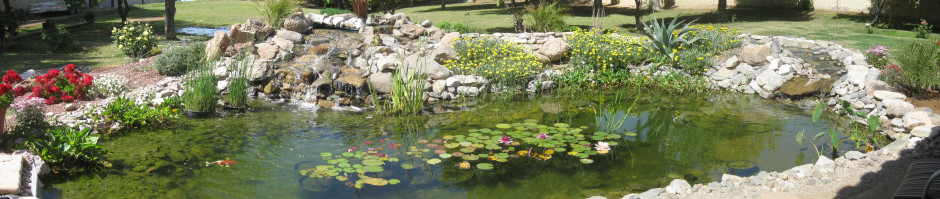
Our pond was built in 2011 and filled with water for the very first time in March of that year. It’s hard to believe it’s nearly 10 years old. Over the years I have written about the ups and downs of creating a Koi fish friendly pond.

Today we have about 30 Koi. It’s hard to know exactly how many because if you’ve ever tried to count fish, you would understand. We have a mix of standard Koi and Butterfly Koi and a herd of little fish called Gambusia (mosquito fish). The Gambusia multiplies like rabbits. We began by throwing in about a dozen given to us by our neighbor and today who know how many? At least a hundred.

It’s a beautiful, end-of-September day in Arizona and so I took a few photos as the pond looks roday.

It’s time to trim the landscaping plants surrounding the pond once again and I’ve discovered a patch of grass in the pond island area that will have to be removed. Basically, the pond has become a rather simple and calming addition to our backyard requiring minimal maintenance.

Our external filter system with a UV light is cleaned once a year. At that time all of the filter media is removed and replaced with clean, fresh media. Every evening, the two main filter pump filters are cleaned. There is a plastic grate at the intake that stops large items like dead lily pad leaves. Then there is a a square net that collects smaller material and finally, there is a green filter mat that collects small material. It probably takes 15 minutes to remove, wash with a hose and replace.

The fish get fed once a day, consistently around 5:30 in the evening. I bring my bowl of Koi food out and call out “dinner” and they all covey up to the feeding spot. It seems to trigger their appetites because after eating the Koi pellets they will spend several hours grazing on any algae on the rocks in the pond. As the weather gets cooler, I will reduce the amount of the daily feeding and in the winter they will get half the amount they receive now.

As the mornings and evenings cool down we are more likely to sit around the pond and watch the fish do their thing.

© Joyce Clark, 2020         

FAIR USE NOTICE

This site contains copyrighted material the use of which is in accordance with Title 17 U.S. C., Section 107. The ‘fair use’ of any such copyrighted material as provided for in Section 107 of the US Copyright Law and who have expressed a prior interest in receiving the included information for research and educational purposes. For more information material on this site is distributed without profit to those who have not always been specifically authorized by the copyright owner. We are making such material available in our efforts to advance understanding of environmental, political, human rights, economic, democratic, scientific and social justice issues, etc. We believe this constitutes a ‘fair use’ of any such material. For more information go to http://www.law.cornell.edu/uscode/17/107.shtml. If you wish to use copyrighted material from this site for purposes of your own that go beyond ‘fair use,’ you must obtain permission from the copyright owner.

Disclaimer: The comments in this blog are my personal opinion and may or may not reflect an adopted position of the city of Glendale and its city council.

I asked city staff to research a series of questions regarding expenditures for Glen Lakes over the years. Much of it was historical data which they could not provide. However, I am sharing the information I did receive.

I asked what the 1979 purchase price was for Glen Lakes. The amount the city paid in 1979 was $1,418,113. I would only remark that the 1979 price was remarkable considering that it was purchased over 40 years ago. It would be considered a remarkable amount of money today as well.

I asked if there were any expenditures required after the land was purchased prior to opening the course to the public. Staff could not find any information.

I assumed the course operations and maintenance would have been a line item in the city’s budget over the years but that was not the case. Costs of operation and maintenance for all city parks and facilities were lumped together so there is no method to determine what would have been expended on the course until 2019. In 2019 the city implemented a new financial software system that now enables the tracking of individual facility expenditures across all departments.

It is fair to assume the city did spend money on operations and maintenance of the course between its purchase date and 2019 when the city could actually begin tracking expenditures. We just don’t know how much was spent each year so I find it puzzling when supporters opposed to the sale of Glen Lakes claim the city deliberately underfunded the operations and maintenance of the course in recent years when they have no factual information to prove it. As can be seen below with regard to attendance figures available attributing the decline in attendance to lack of maintenance seems unrealistic when nationwide golf course attendance declined.

We do know the city paid Golf Maintenance Solutions $120,500 in 2018. We do know that city expended $394,537 in 2019; another $166,691 in 2020; and another $65,000 in 2020. I asked what the city has spent on course maintenance since its closure. That figure is $261,634.

Factually, it can be documented that between the purchase price and the expenditures identified since 2018, the city has spent approximately $3,164,841.00 plus whatever expenditures there were between 1979 and 2018. Over 40 years, it is fair to say the expenditures were considerable and could be considered in the millions of dollars but there is no means of verification.

I asked what the attendance at the course had been since 2005. I have heard Glen Lakes advocates say repeatedly that in 2005 the course was very popular. I asked staff if they had any data on attendance and they provided:

  • 2005 47,469
  • 2006 46,947
  • 2007 42,999
  • 2008 39,455
  • 2009 39,999
  • 2010 33,577
  • 2011 25,104
  • 2012 21,377
  • 2013 22,788
  • 2014 19,196
  • 2015 18,420
  • 2016 15,483
  • 2017 unknown
  • 2018 12,240

I discovered many 9 hole municipal golf courses throughout the country whose annual attendance is twice that of Glen Lakes at its peak in 2005.  By 2016 users of Glen Lakes had declined by 67% from the 2005 figure.

An article entitled Course Correction published in September of 2019 sums up the current issues associated with municipal golf courses, “But over the past 15 years, golfing participation has fallen by 20 percent, from 30 million in 2005 to 24 million today. Now, according to the National Golf Foundation, there are more municipal courses than ever—some 2,800 across the country—but they are serving far fewer golfers than they once did. As a result, course costs are cutting into city budgets. One-third of public golf courses don’t make enough to cover annual operations. That number goes up when taking into account other expenses, such as debt and employee retirement benefits.”(https://www.governing.com/topics/finance/gov-golf-courses.html).

There is another issue that has surfaced recently with regard to Glen Lakes and that is, the issue of the park space to be reserved for public use. Currently, other than the view provided to adjacent neighbors, to actually be on the golf course one would have to pay a fee to use it so consequently the only benefit to neighbors is the view.

It should be noted that there is quite a bit of established park space in this area. Close by are Butler Park and Manistee Ranch Park. A little further is one of Glendale’s premier parks, that of Sahuaro Ranch Park.

I attended the public meetings for neighborhood residents. At one of those meetings conceptual plans were offered for proposed park space and the amount of improved park land is to be + or – 10 acres. The attendees were the ones who chose the final conceptual plan and they made it quite clear that they did not want a park with active amenities such as basketball courts that would attract users from outside their neighborhoods. Now to hear complaints about the configuration of the park space is quite baffling.

The city council will be voting on this issue sometime in October. I have no idea how the vote will go. There are several issues to consider. Does the city need two 9 hole municipal golf courses? Is it cost effective to maintain a view for the adjacent neighbors? Should this course be preserved no matter the current and future costs to be borne by all of the city’s taxpayers? Would the funding to operate and maintain 10 acres of useable, neighborhood, public park space be a better investment for the city?

I understand the Glen Lakes advocates’ position. Their request is to restore the course. I represent all citizens of Glendale. Is it fair, just and equitable to ask every taxpayer in Glendale to subsidize millions of future dollars to completely renovate, operate and maintain this course? Even if the course were renovated, it is anticipated the revenues earned by players’ fees would not cover the annual costs of operation and maintenance. The reality is that this course will be a financial deficit to the city in perpetuity.

It is always jarring and upsetting to residents when they are confronted with the fact that a once vacant parcel of land nearby will be developed. Their first comment is on the loss of their unimpeded view enjoyed for many years.

As Planning Chairperson Gary Hirsch said at a recent meeting, if this were a parcel owned by a private entity wishing to develop, it would be recognized and acknowledged that the private entity has the right to so as it wished with its investment. He drew a line in the sand when it came to a public entity, namely local government, and its desire to develop or to repurpose land that it owns. I’m not sure I agree with his premise. Taxpayers constantly question whether its local government is making sound financial decisions and operating in the most cost effective manner possible. Doesn’t local government have the obligation to stop throwing good money after bad?

I understand the anguish of nearby neighbors and the loss of their view of 40 acres of green space but at what cost do the rest of the taxpayers preserve the neighbors’ view?

© Joyce Clark, 2020         

FAIR USE NOTICE

This site contains copyrighted material the use of which is in accordance with Title 17 U.S. C., Section 107. The ‘fair use’ of any such copyrighted material as provided for in Section 107 of the US Copyright Law and who have expressed a prior interest in receiving the included information for research and educational purposes. For more information material on this site is distributed without profit to those who have not always been specifically authorized by the copyright owner. We are making such material available in our efforts to advance understanding of environmental, political, human rights, economic, democratic, scientific and social justice issues, etc. We believe this constitutes a ‘fair use’ of any such material. For more information go to http://www.law.cornell.edu/uscode/17/107.shtml. If you wish to use copyrighted material from this site for purposes of your own that go beyond ‘fair use,’ you must obtain permission from the copyright owner.